

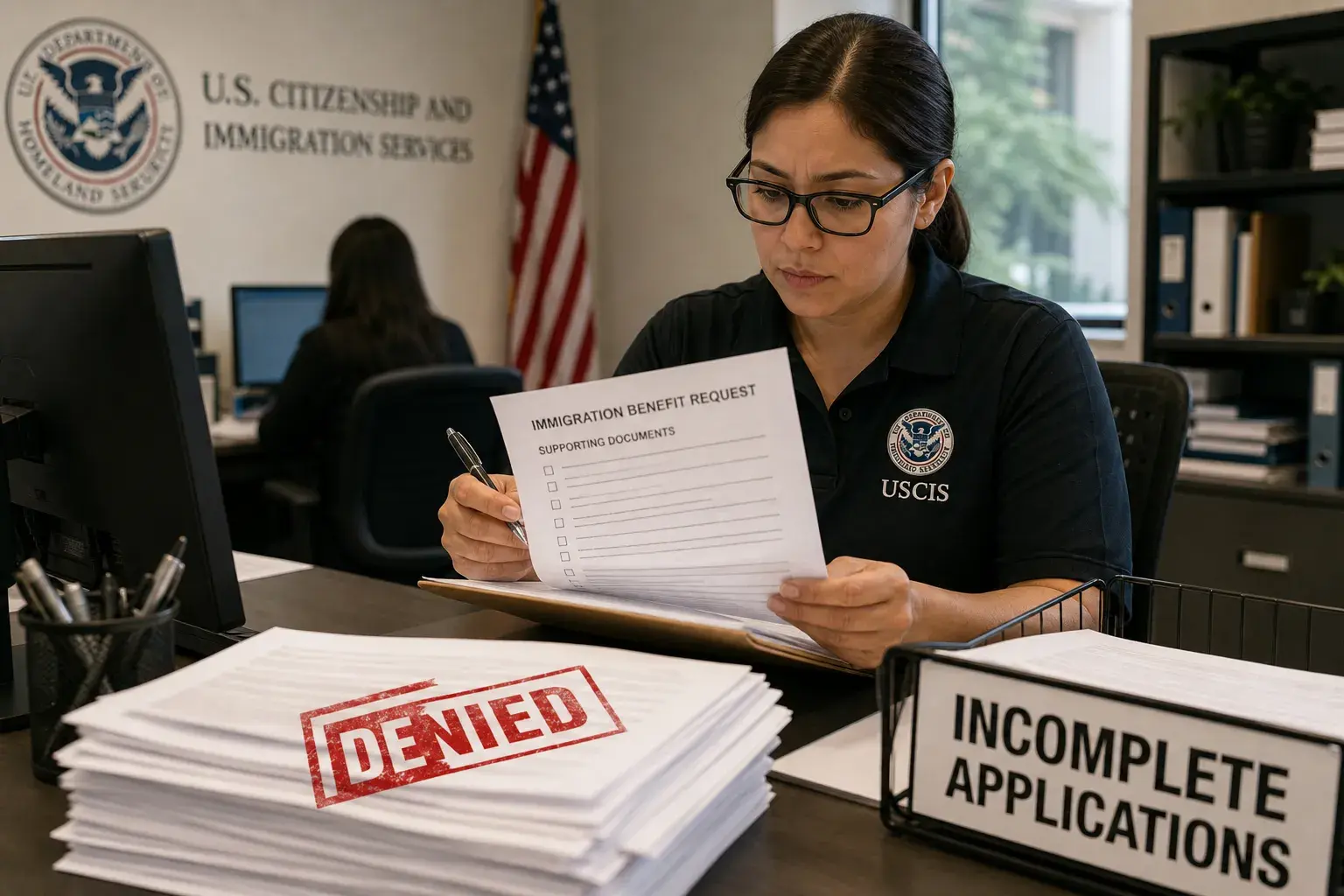
USCIS has restored broader officer discretion to deny incomplete benefit requests, increasing the importance of submitting required documents and persuasive evidence with the initial filing.
What USCIS Changed
U.S. Citizenship and Immigration Services announced the policy update on August 5, 2026, as part of an effort to discourage frivolous or substantially incomplete applications, petitions, and other immigration benefit requests.
Under the revised guidance, officers generally have discretion to deny a request without first issuing a Request for Evidence, known as an RFE, or a Notice of Intent to Deny, known as a NOID. USCIS identified situations that may justify this approach, including when a request has no legal basis for approval or when the requestor fails to provide required initial evidence.
RFEs and NOIDs have not been eliminated. Officers may still use them when additional evidence or an explanation is appropriate, and existing laws or regulations may require advance notice in certain proceedings. The change instead removes the expectation that applicants will usually receive another opportunity to repair an incomplete record.
Why Complete Filings Matter
Immigration benefit requestors carry the burden of proving that they qualify for the benefit sought. In most USCIS proceedings, eligibility must be shown by a preponderance of the evidence, meaning the relevant claim is more likely than not to be true.
The distinction between rejection and denial is also important. A lockbox may reject a filing that does not meet basic acceptance requirements, such as a missing signature or incorrect payment. A denial occurs after USCIS accepts the request and an officer determines that the record does not support approval. A denial can result in lost filing fees and may require a motion, appeal, or new filing, depending on the benefit and circumstances.
USCIS also emphasized that the maximum response period for an RFE is not an automatic 12-week allowance in every case. The agency may set a shorter period based on the evidence requested and other circumstances. The deadline printed on the notice controls.
Practical Impact for Filers
For international students and professionals, the guidance can matter when preparing applications for extensions or changes of status, employment-based petitions, employment authorization, or adjustment of status. Filers should review the current form edition and instructions, confirm that every required document is included, and organize evidence around each eligibility requirement.
Applicants should not treat an initial submission as a placeholder or assume that USCIS will request missing material later. Those responding to an RFE or NOID should submit a complete response by the stated deadline because USCIS generally does not extend these response periods.
This article provides general information and is not legal advice. Immigration consequences depend on the benefit category and individual record.
Sources
- USCIS to Reduce Frivolous Immigration Benefits Requests by Reinforcing Evidence Standards — USCIS (August 5, 2026)
- Evidentiary Standards — USCIS (August 5, 2026)
- 8 CFR 103.2 — Submission and Adjudication of Benefit Requests — Electronic Code of Federal Regulations (August 5, 2026)

Share

Appeals Court Lets Block on $100,000 H-1B Fee Take Effect
U.S. Reschedules Immigrant Visa Interviews for Training

No Comments Yet
Let us know what you think