

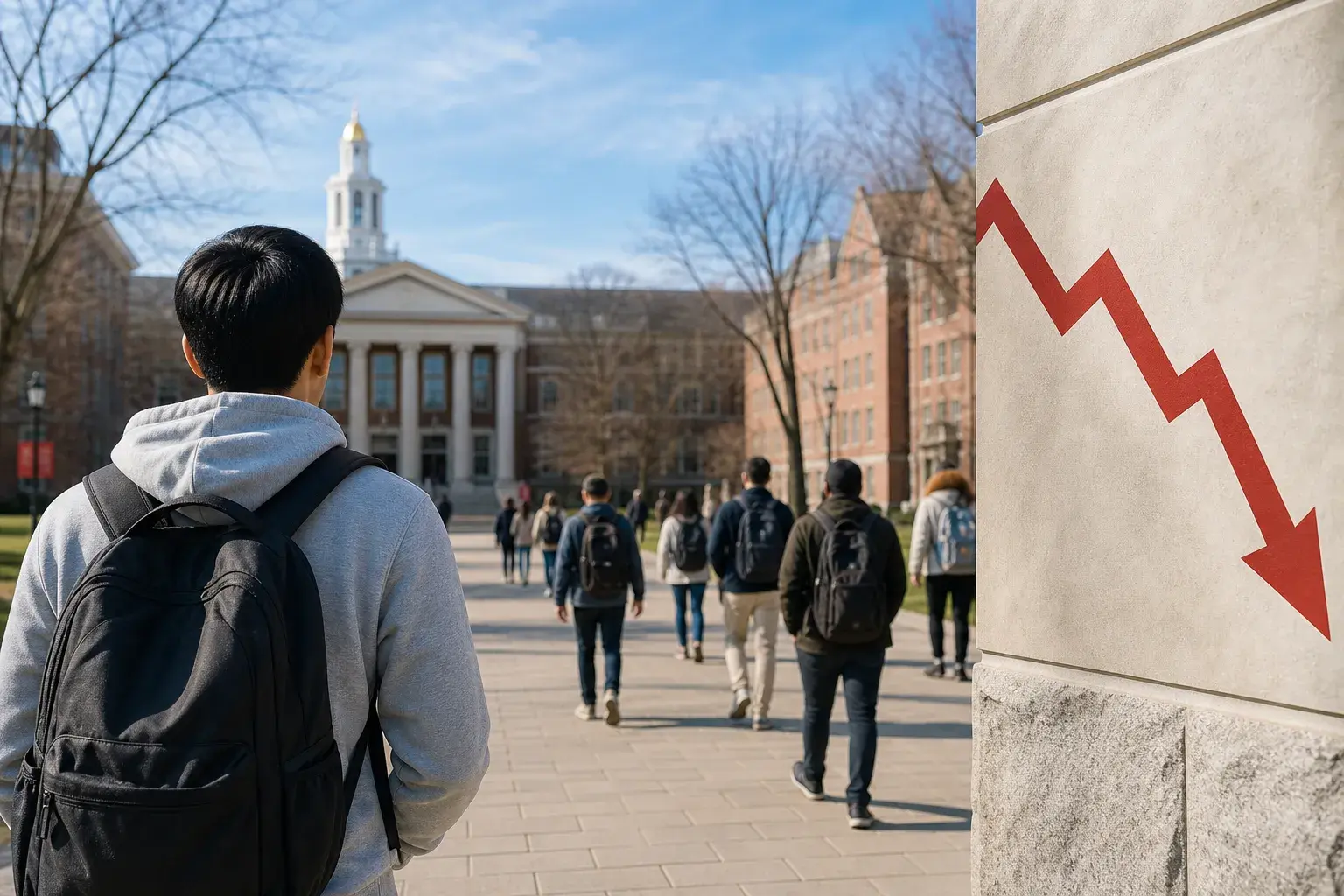
A projected decline in international enrollment could cost the U.S. $3.4 billion, adding financial pressure for universities and the communities that depend on student spending. The forecast also points to broader concerns about whether the country can remain a leading destination for global talent.
A Steeper Enrollment Drop
Research released by NAFSA: Association of International Educators and JB International on August 11, 2026, estimates that U.S. colleges and universities could enroll as many as 111,000 fewer international students during the 2026-27 academic year.
Under the report's upper-range scenario, international enrollment would fall from an estimated 1.17 million students in 2025-26 to about 1.06 million in 2026-27. That would represent a decline of roughly 9.5% and could reduce international students' direct economic contributions from approximately $41.8 billion to $38.4 billion.
The analysis also estimates that the decrease could affect nearly 40,000 U.S. jobs supported by tuition payments and spending on housing, food, transportation and other services.
Campuses Expect Fewer Students
The projection draws partly on the Institute of International Education's Spring 2026 Snapshot, which collected responses from 585 U.S. higher education institutions. The survey found that 63% of responding institutions expect enrollment to fall in the 2026-27 academic year. Only 11% anticipated growth, while 26% expected international enrollment to remain stable.
Other indicators suggest that graduate education may be particularly exposed. Data collected from 55 major research universities showed that international applications to doctoral programs declined 21% for fall 2026, while international admissions fell 17%.
NAFSA linked the outlook to several overlapping factors, including weaker application volumes, visa appointment and processing difficulties, travel restrictions and changes affecting international students' immigration status. However, the organization acknowledged important limits in its model, including incomplete visa issuance data and differences in how institutions interpreted survey terms such as slight or substantial decline.
What Students Should Watch
For prospective and current international students, falling enrollment does not automatically mean fewer opportunities at every institution. The effects are likely to vary by university, degree level and location. Still, schools facing substantial revenue losses could reconsider recruitment budgets, scholarships, graduate assistantships or international student services.
The figures remain projections rather than confirmed enrollment totals. More complete fall 2026 data will be needed to determine the actual decline. Students making education or immigration decisions should therefore confirm program funding, visa timelines and institutional policies directly with universities and qualified advisers.
Sources
- Projected Loss Of International Students Could Bring A $3.4 Billion Hit — Forbes (August 12, 2026)
- Fall 2026 International Student Enrollment Outlook & Economic Impact — NAFSA: Association of International Educators (August 11, 2026)
- Spring 2026 Snapshot on International Educational Exchange — Institute of International Education (July 1, 2026)

Share

H-1B and L-1 Extension Fees Could Rise Under DHS Plan

U.S. Weighs $100,000 Fee for International Student OPT

No Comments Yet
Let us know what you think