

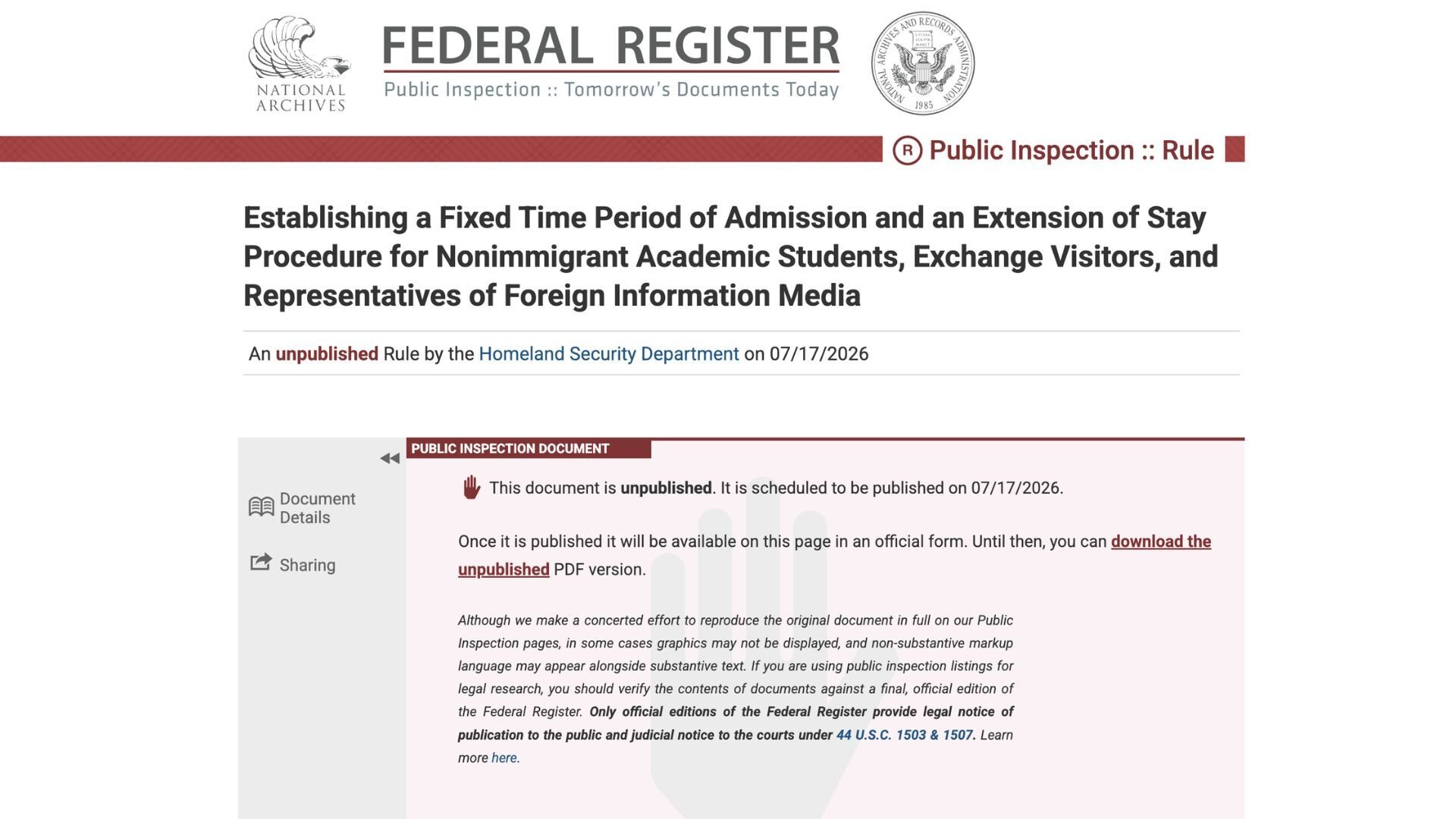
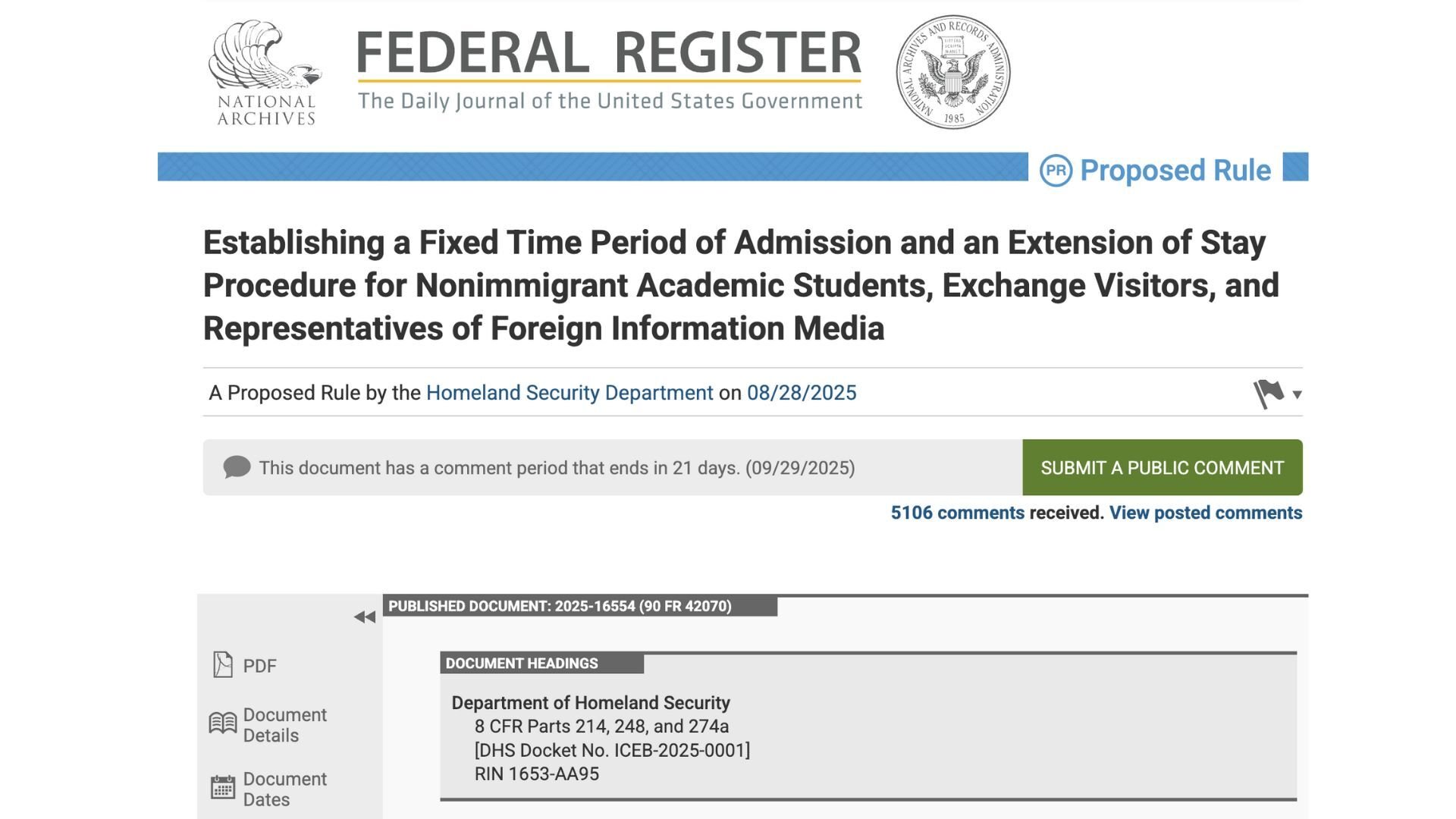
It's official. On July 17, 2026, the Department of Homeland Security is publishing the final rule that ends "Duration of Status" (D/S) for F-1 students. After nearly 22,000 public comments, DHS adopted almost everything it proposed back in August 2025 — and the rule takes effect 60 days after publication, meaning around mid-September 2026.
If you're an international student in the U.S. or planning your next program, this changes how long you can stay, how you extend, and which degree paths remain open to you.
-Jul-16-2026-05-08-53-3622-PM.jpg?width=1920&height=1080&name=GoElite.com%20Square%20Design%20(1)-Jul-16-2026-05-08-53-3622-PM.jpg)
1. What's changing: the big picture
For decades, F-1 students were admitted for "Duration of Status" — no fixed end date on your I-94. As long as your DSO kept your SEVIS record active, you could finish a degree, start another, extend your program, and never file anything with USCIS.
That era is ending. Under the final rule:
1. Your I-94 will have a fixed end date. You'll be admitted for the length of your program on your I-20, capped at 4 years, plus a 30-day window before your program starts and 30 days after it ends.
2. Staying longer means filing with USCIS. If you need more time — to finish your program, start post-completion OPT, or begin a new program — you'll file a formal Extension of Stay (EOS) application (Form I-539) with USCIS, including a fee and possible biometrics. A DSO updating your SEVIS record is no longer enough.
3. The grace period shrinks from 60 to 30 days. After completing your program or OPT, you'll have 30 days to depart, change status, or start something new. And if you finish your program early, the 30-day clock starts from your actual end date — not the date on your I-20.
4. Overstaying gets riskier. With a fixed I-94 date, unlawful presence starts accruing the day after your admission expires. Under D/S, that generally only happened after a formal government finding. The stakes for missing a deadline are now much higher.
5. New limits on switching schools, majors, and degree levels.
- First year, first school: You generally must complete your first academic year at the school that issued your initial I-20 before transferring or changing your educational objective — unless SEVP authorizes an exception for extenuating circumstances.
- Graduate students are locked in: At the master's level or above, you cannot change your major at any point in your program, and transfers are prohibited unless SEVP grants an extenuating-circumstances exception.
- No same-level or lower-level second degrees: Once you complete a program after the rule takes effect, you can only start a new program at a higher educational level. A second master's after your first master's will no longer be an option — the next step up is a doctorate.
2. What this means for OPT and STEM OPT
OPT survives — but the paperwork and the deadlines around it change significantly.
Post-completion OPT becomes a two-application process. Under D/S, applying for OPT meant one form: the I-765 work permit application. Under the final rule, if your I-94 expires before your OPT would end (which it usually will), you'll need an approved
Extension of Stay (I-539) and the I-765 — two applications, two fees. The alternative is traveling abroad and re-entering through CBP with your OPT-endorsed I-20, which comes with its own risks while an application is pending.
Transition relief — if you act early. Students who file for post-completion OPT or a STEM OPT extension within roughly the first 6 months after the rule takes effect skip the EOS entirely: only the I-765 is required, just like today. If your OPT application will land in that window, this is meaningful — after it closes, the two-application process becomes the norm.
Deadlines tighten from 60 to 30 days. You must file your OPT application within 30 days of your program end date (previously 60), and your requested OPT start date can't be more than 30 days after your program ends. Miss the window and the option is gone.
Working while applications are pending. If your I-94 expires while your timely filed EOS is pending, you can stay and continue studying — but you cannot start OPT employment until both the EOS and the work permit are approved. Two exceptions help: students already on post-completion OPT who file for the STEM extension keep the existing 180-day automatic extension of their current EAD, and the H-1B cap-gap protection is unchanged — timely filed cap-subject petitions still auto-extend status and work authorization.
Your I-94 during OPT. When admitted or extended for OPT, your fixed end date will generally run to your EAD expiration or your DSO's recommended OPT end date (whichever is later), plus a 30-day departure period. When OPT ends, you have 30 days — not 60 — to leave, change status, or move into a higher-level program.
The bottom line: OPT still works, but it now demands earlier planning, cleaner dates, and zero missed deadlines. Students who used to treat the OPT application as a formality will need to treat it as a filing strategy.
3. What about Day 1 CPT? Read this carefully.
There's a lot of misinformation circulating, so let's be precise about what the rule actually says.
The rule does NOT eliminate CPT or Day 1 CPT. DHS said this directly in the final rule, responding to commenters who feared a ban: "These comments misinterpret the rule as the rule does not prohibit or eliminate Day-1 CPT... it does not make substantive changes to CPT." Day 1 CPT programs remain lawful exactly as they are today.
But the rule reshapes the landscape around Day 1 CPT in four important ways:
1. The "second master's" pathway is closing. Many students have historically used OPT after one master's, then enrolled in a second master's with Day 1 CPT to continue working. Under the final rule, anyone completing a program after the effective date can only move up a level. If continuing your U.S. journey matters to you, the realistic next step after a master's is a doctorate program (DBA, Ed.D., Ph.D., etc.) — many of which also offer Day 1 CPT. One important nuance in the final rule: this ban is not retroactive. It applies to programs completed after the effective date — which makes the timing of your current program's end date genuinely important.
2. CPT must fit inside your fixed admission period. DHS confirmed that CPT "must be completed within the authorized period of admission." If your program runs longer than your I-94 date, you'll need an approved EOS. The good news: if you timely file your EOS before your I-94 expires, you can keep pursuing your full course of study — and continue authorized CPT for up to 240 days — while USCIS processes your application.
3. Program extensions get harder. Delays caused by academic probation, suspension, or repeated failure to finish coursework are now generally unacceptable reasons for a program extension. Staying enrolled and in good standing matters more than ever.
4. Timing your enrollment matters. Students already in the U.S. on D/S when the rule takes effect keep their current terms: you're authorized through the program end date on your current I-20 (up to 4 years from the effective date), plus the old 60-day grace period. Starting your next program — or completing a transfer — before the rule takes effect means operating under today's simpler SEVIS process rather than tomorrow's USCIS filings and level restrictions.
4. Your 60-day window: what to do now
The clock between publication (July 17) and the effective date (~mid-September) is short. Here's how we'd prioritize:
- Find your program end date. It's on your I-20. That date — not a vague "someday" — now defines your timeline.
- If you're finishing a program in the next 6–12 months, decide your next step now: OPT, a higher-level program, or departure. The same-level ban and the 30-day grace period make last-minute pivots much harder after the rule takes effect.
- If you're considering a second program, understand that after the effective date, it must be at a higher level. Enrolling before the rule takes effect keeps more doors open.
- If you're on OPT or applying soon, note the transition relief: students who timely file for post-completion OPT or STEM OPT within roughly the first 6 months after the rule takes effect only need the employment authorization application — no separate EOS filing.
- Talk to your DSO — and get a second set of eyes on your plan. Every situation is different, and small date mismatches (I-20, I-94, EAD, travel) are where students get hurt under fixed-date rules.
5. Don't navigate this alone
GoElite has helped thousands of international students plan their F-1 journey — including matching students with accredited, SEVP-certified hybrid professional master's and doctorate programs that fit their work situation, budget, and timeline.
With the rule now final, we're offering free 15-minute planning calls to map your specific dates: your program end date, the rule's effective date, which programs and intakes keep you compliant, and whether acting before mid-September makes sense for you.
Book your free planning call with GoElite →
Or reach out to our advising team - we'll send you a personalized program shortlist matched to your graduation date and career goals.


Share
DHS New Proposal Breakdown: Why It's Harmful to All F1 Students
DHS Ends ‘Duration of Status’ for F‑1 Students, Starting Sept. 15
No Comments Yet
Let us know what you think